
Infusion Pump and Syringe Driver Accuracy Testing in Kenya
Short answer: infusion pump and syringe driver accuracy testing checks that the volume a pump actually delivers matches the rate programmed into it, measured gravimetrically or with a dedicated flow analyser rather than trusted from the display. This matters because an infusion pump’s failure mode is not always a visible alarm, a pump can run for hours delivering a dose that is quietly wrong before anyone notices. Testing is carried out against IEC 60601-2-24, the particular standard for infusion pumps and controllers, and covers flow rate accuracy, occlusion alarm response, bolus accuracy, and free-flow protection.
On this page
What infusion pump accuracy testing actually checks
An infusion pump or syringe driver is a dosing instrument, and a dosing instrument that drifts out of accuracy is delivering the wrong amount of a drug without anyone necessarily seeing it happen. Accuracy testing uses a calibrated flow analyser or a gravimetric setup, weighing the actual volume delivered over a timed run, rather than relying on the pump’s own internal counter. A full test covers:
- Flow rate accuracy: the actual delivered volume per hour at several programmed rates, including low rates used for neonatal and paediatric dosing, where small absolute errors matter most
- Bolus accuracy: for pumps offering bolus delivery, whether the delivered bolus volume matches the programmed amount
- Occlusion alarm pressure and response time: whether the pump detects a blocked line at the specified pressure threshold and alarms within an acceptable time, rather than continuing to push against a blockage
- Free-flow protection: whether the mechanism that should prevent gravity free-flow when the administration set is removed from the pump actually engages
- Air-in-line and door/clamp sensor function: whether the safety interlocks trigger correctly rather than being bypassed by a worn sensor
- Battery runtime: whether the pump holds its charge long enough to cover a realistic transport or power-outage scenario
Syringe drivers, used for smaller, more precise volumes than large-volume pumps, are tested the same way but are generally held to tighter accuracy tolerances given the lower absolute volumes and higher-concentration drugs they are often used to deliver.
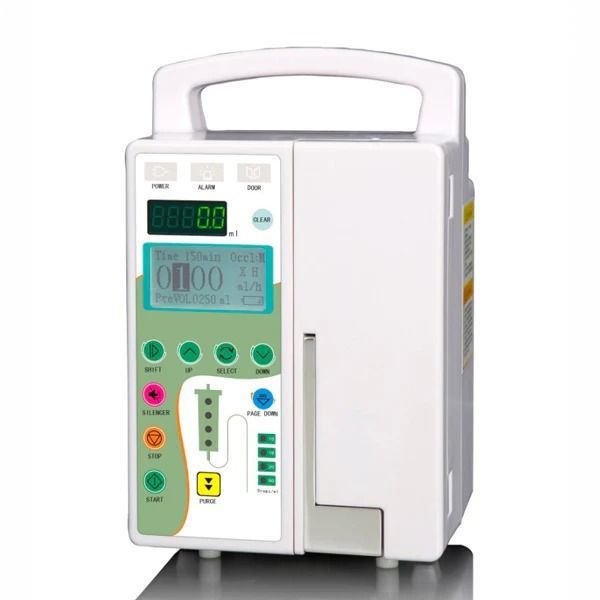
IEC 60601-2-24: the standard behind it
IEC 60601-2-24, “particular requirements for the basic safety and essential performance of infusion pumps and controllers,” sets out the performance requirements covering flow accuracy limits, alarm conditions, and the specific hazards unique to infusion equipment, such as free-flow and occlusion. It applies to large-volume infusion pumps, syringe drivers, and ambulatory infusion devices alike, with testing requirements scaled to how each device category is actually used.
As with the standards covered in our electrical safety testing guide and patient monitor calibration guide, this is a performance standard for the device’s design. The in-service accuracy check described above is what confirms a specific pump, years into its working life, still performs within that envelope.
How often pumps and syringe drivers need testing
Our general guide to calibration intervals for medical equipment places infusion pumps and syringe drivers in the life-critical category alongside patient monitors and defibrillators, tested roughly every six months. Pumps in continuous heavy use, such as those on a neonatal unit or in theatre, warrant checking against the manufacturer’s recommended interval rather than defaulting to the general figure, since duty cycle affects both mechanical wear and how quickly a drift would actually be noticed clinically.
Signs a pump is dosing inaccurately
A handful of signs are worth acting on rather than waiting for the next scheduled test: a patient’s clinical response consistently out of step with the programmed dose, an occlusion alarm that takes noticeably longer to trigger than it used to, visible wear or play in the drive mechanism, or a pump that has recently been dropped or exposed to fluid. None of these confirms an accuracy fault by itself, but each is a reason to pull the pump from use and test it rather than assume it is still within tolerance.
What Kenya does and doesn’t mandate here
We could not find a Kenya-specific regulation that sets a mandated accuracy-testing interval for infusion pumps or syringe drivers by name. Device registration and importation fall under the Pharmacy and Poisons Board (PPB), and facility licensing under the Kenya Medical Practitioners and Dentists Council (KMPDC), neither of which specifies an in-service accuracy schedule for this equipment category.
Where a facility wants a documented, defensible record, the same Kenya Accreditation Service (KENAS) accredited calibration route covered in our x-ray machine calibration guide applies here. A certificate stating the actual measured flow rates against the programmed rates, rather than a generic sign-off, is what an inspector or insurer would expect to see.
Who handles pump testing for Jodroc clients
Jodroc supplies and services infusion pumps and syringe drivers as part of our calibration and compliance testing service, carried out on schedule with a certificate per machine stating measured flow accuracy against programmed rates. Where a tender or inspection requires accredited calibration specifically, we coordinate with KENAS-accredited providers rather than issuing our own accreditation.
Pumps are frequently due around the same time as defibrillators and patient monitors on a ward or in theatre, and we can schedule all three together in one visit.
Need your infusion pumps or syringe drivers tested? Jodroc supplies and services infusion equipment in Nairobi and can schedule accuracy testing across your fleet.
Frequently asked questions
What does infusion pump accuracy testing check?
Flow rate accuracy at several programmed rates, bolus accuracy, occlusion alarm pressure and response time, free-flow protection, air-in-line and door sensor function, and battery runtime.
How often should pumps and syringe drivers be tested?
Roughly every six months as life-critical equipment, with pumps in heavy continuous use, such as neonatal or theatre units, checked against the manufacturer’s recommended interval.
What is the difference between a syringe driver and an infusion pump?
A syringe driver delivers smaller, more precise volumes and is generally held to tighter accuracy tolerances than a large-volume infusion pump, though both are tested the same way, against a calibrated flow analyser.
What standard governs infusion pump testing?
IEC 60601-2-24 sets the particular performance requirements for infusion pumps and controllers, covering flow accuracy limits and hazards specific to infusion equipment such as free-flow and occlusion.
Does Kenya require infusion pump testing by law?
We could not find a Kenya-specific regulation mandating a fixed testing interval for infusion pumps or syringe drivers. Testing is documented against KENAS-accredited labs where a defensible certificate is needed.
Sources: IEC 60601-2-24, “Medical electrical equipment: particular requirements for the basic safety and essential performance of infusion pumps and controllers” (International Electrotechnical Commission). Where a Kenya-specific mandated interval could not be verified against a current official source, that gap is stated explicitly above rather than filled with an estimate.
Pricing a new unit rather than testing an existing one? See our guide to infusion pump prices in Kenya.