
Defibrillator Testing and Compliance in Kenya
Short answer: defibrillator testing checks that the device can actually deliver the energy it claims to, on demand, every time, by discharging into a calibrated energy analyser rather than trusting the unit’s own self-check display. It covers energy output accuracy, charge time, battery condition, and the automated external defibrillator’s (AED) shock-advisory algorithm where fitted, tested against IEC 60601-2-4, the particular standard for cardiac defibrillators. A defibrillator that fails this check silently is one of the few pieces of equipment where the failure mode is immediate and irreversible, which is why testing it is not optional maintenance but a resuscitation-readiness requirement.
On this page
What defibrillator testing actually checks
A defibrillator sits unused for most of its working life, which is exactly the problem: a fault can develop between emergencies with nobody noticing until the one moment the device is needed. A proper test discharges the unit into a dedicated defibrillator analyser rather than a dummy load or a wall, and checks:
- Energy output accuracy: the delivered joules at each selected energy setting, measured against the displayed value, since a unit that reads 200J but delivers less is a silent failure a visual check cannot catch
- Charge time: how long the unit takes to reach full charge at its highest energy setting, which matters directly in a resuscitation where seconds count
- Battery condition and runtime: capacity testing rather than a simple charge-indicator glance, since a battery can show full charge and still fail under the brief high-current draw a shock demands
- ECG and synchronisation accuracy: for defibrillators offering synchronised cardioversion, whether the shock actually times to the R-wave as displayed
- AED shock-advisory algorithm: for automated units, whether the rhythm-analysis software correctly advises shock or no-shock against known reference waveforms, using a simulator built for that purpose
- Paddles, pads, and cables: visual and continuity checks on the patient-contact hardware, which fails more often in practice than the generator electronics themselves
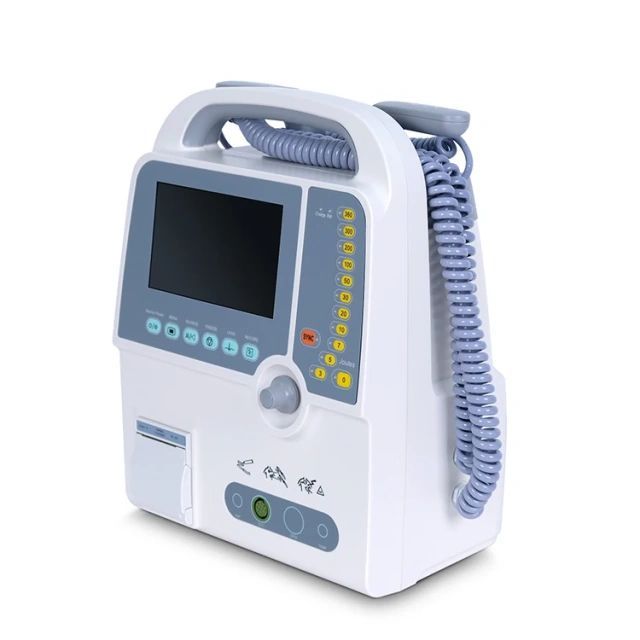
IEC 60601-2-4: the standard behind it
IEC 60601-2-4, “particular requirements for the basic safety and essential performance of cardiac defibrillators,” sets the performance requirements a defibrillator must meet, including energy delivery accuracy, charge time limits, and the safety interlocks that prevent an accidental discharge. It covers both manual defibrillators used by clinicians and the automated units designed for lay or first-responder use.
Like the other recurrent-testing standards covered in our electrical safety testing guide, the design standard is only half the picture. A device engineered correctly on day one still needs periodic verification that it has not drifted out of that performance envelope through component ageing, battery degradation, or an undetected fault.
How often a defibrillator needs testing
Our general guide to calibration intervals for medical equipment places defibrillators in the life-critical category, tested roughly every six months, the same interval as patient monitors and infusion pumps. Given how rarely a defibrillator is actually used, that fixed calendar interval matters more than usage-based scheduling, since there is no duty cycle to read drift from. A unit that has sat untouched for six months is not a unit that can be assumed fine.
A full energy-output and battery capacity test should also be triggered outside the regular schedule after any event where the unit was actually used clinically, after a battery replacement, or after the device has been dropped or exposed to fluid ingress, none of which should wait for the next six-month round.
Daily readiness checks vs. full testing
Most facilities that keep a defibrillator on a crash trolley also run a daily or shift-based readiness check: confirming the battery indicator, running the unit’s built-in self-test, checking pads are in date and sealed, and confirming the unit is physically present and accessible. This is valuable and should happen, but it is not a substitute for the periodic energy-output and battery capacity test described above. A self-test confirms the device’s internal electronics report themselves healthy, it does not confirm the delivered energy at the terminals matches the display, which is the actual patient-safety question.
What Kenya does and doesn’t mandate here
We could not find a Kenya-specific regulation that sets a mandated testing interval for defibrillators by name. Facility licensing through the Kenya Medical Practitioners and Dentists Council (KMPDC) and device registration through the Pharmacy and Poisons Board (PPB) cover whether a facility may operate and whether the device may be imported and sold, neither reaches into an in-service testing schedule for equipment already on a crash trolley.
In the absence of a named Kenyan mandate, the six-month interval and full discharge test described above are followed because resuscitation equipment failure has an immediate consequence, not because a regulator requires a specific certificate. A facility that wants a defensible record for an inspection or insurer should still ask for a dated certificate against Kenya Accreditation Service (KENAS) accredited calibration, the same accreditation route covered in our x-ray machine calibration guide.
Who handles defibrillator testing for Jodroc clients
Jodroc supplies and services defibrillators and crash trolley equipment as part of our calibration and compliance testing service, carried out on schedule with a certificate per machine stating the actual measured energy output, charge time, and battery condition rather than a bare pass stamp. Where a specific inspection or tender requires accredited calibration, we coordinate with KENAS-accredited providers rather than issuing our own accreditation.
If your defibrillator is due for calibration alongside a patient monitor or ECG check, which is common since crash trolley equipment is often tested together, we can schedule both in the same visit.
Need your defibrillators tested? Jodroc supplies and services resuscitation equipment in Nairobi and can schedule testing across your crash trolleys and theatres.
Frequently asked questions
What does defibrillator testing check?
Energy output accuracy, charge time, battery condition and capacity, ECG synchronisation where fitted, the AED shock-advisory algorithm on automated units, and the condition of paddles, pads, and cables.
How often should a defibrillator be tested?
Roughly every six months as a life-critical device, plus an additional check after any clinical use, battery replacement, drop, or fluid exposure, regardless of where that falls on the regular schedule.
Is a daily self-test enough on its own?
No. A daily self-test confirms the device’s internal electronics report healthy. It does not confirm the delivered energy at the terminals matches the display, which only a periodic test against a calibrated analyser can do.
What standard governs defibrillator testing?
IEC 60601-2-4 sets the particular performance requirements for cardiac defibrillators, covering both manual units and automated external defibrillators.
Does Kenya require defibrillator testing by law?
We could not find a Kenya-specific regulation mandating a fixed testing interval for defibrillators. Testing is carried out because resuscitation equipment failure has an immediate consequence, and is documented against KENAS-accredited labs where a defensible certificate is needed.
Sources: IEC 60601-2-4, “Medical electrical equipment: particular requirements for the basic safety and essential performance of cardiac defibrillators” (International Electrotechnical Commission). Where a Kenya-specific mandated interval could not be verified against a current official source, that gap is stated explicitly above rather than filled with an estimate.
Pricing a new unit rather than testing an existing one? See our guide to defibrillator prices in Kenya.